Digital Cash Stuffing: The TikTok Trend That Actually Works
If you've spent any time on TikTok or Instagram, you've seen cash stuffing videos: people sorting bills into labeled envelopes or binder pouches. The hashtag #cashstuffing has over 4 billion views. But here's the thing — the method behind the trend is real, proven, and over 100 years old. It's the envelope budgeting method. And you don't need cash to do it.
Why cash stuffing went viral
Cash stuffing is satisfying. Physically handling money makes spending feel real. Watching envelopes fill up (or empty out) creates a tangible connection to your budget. It's visual, it's tactile, and it makes for great content.
But more importantly, it works. The envelope method forces a hard limit on each spending category. When the envelope is empty, you stop. No negotiations, no "I'll make it up next month." It's the simplest budgeting system that exists.
Gerencie seu orçamento facilmente
Baixe o Plan & Multiply e comece a agir hoje.
Descobrir o app

The problem with physical cash stuffing
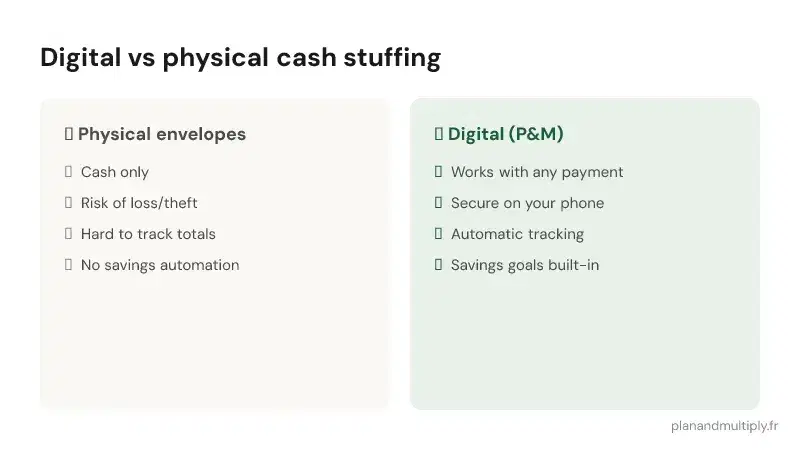
Most of us don't pay with cash anymore. Card payments, online shopping, subscriptions — none of these work with physical envelopes. Carrying large amounts of cash also creates security risks. And splitting cash between physical envelopes doesn't generate any records for tracking.
How digital cash stuffing works
Digital cash stuffing gives you the same psychological benefits — visual limits, category-based spending, the satisfaction of staying under budget — without the practical downsides of cash.
With Plan & Multiply, you create digital envelopes for each spending category. You set a monthly budget for each one. Every time you make a purchase (even by card), you log it in the corresponding envelope. The app shows your remaining balance visually, just like a physical envelope getting lighter.
Setting up your digital cash stuffing system
Step 1: List your variable spending categories. The classics: groceries, dining out, entertainment, shopping, gas/transport, personal care, coffee/snacks.
Step 2: Assign a monthly limit based on your last 3 months of actual spending. Be realistic — this isn't about restriction, it's about awareness.
Step 3: Log every purchase. It takes 10 seconds. Open the app, tap the envelope, enter the amount.
Step 4: Check your Serenity Score at the end of each week. It tells you how you're doing across all categories — one number, instantly understandable.
Digital vs physical: which is better?
Physical cash stuffing has stronger visual impact — you literally see money disappear. But digital cash stuffing wins on every practical dimension: it works with card payments, it generates automatic reports, it supports couple sharing, and it's always in your pocket.
The best approach? Start digital. If you want the tactile experience, use physical envelopes for one or two categories (like groceries or dining out) and digital for everything else.
Why Plan & Multiply is built for this
Plan & Multiply was designed around the envelope method from day one. Unlike apps that bolted on "envelopes" as an afterthought, it's the core of the experience. No bank connection needed — your data stays on your phone. And the Serenity Score makes it feel like a game you actually want to win.