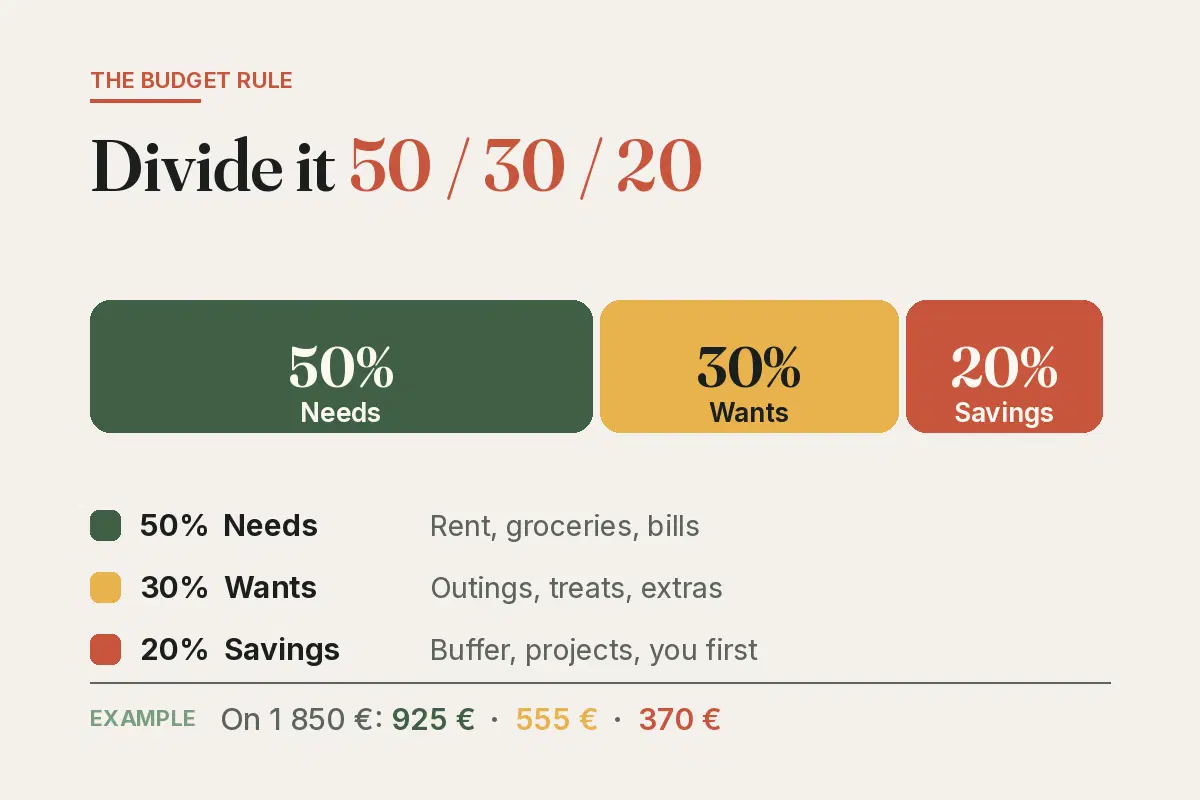
What is the 50/30/20 budget rule?
The 50/30/20 rule is a simple budgeting framework popularized by Senator Elizabeth Warren in her book All Your Worth. The idea is straightforward: split your after-tax income into three broad categories.
- 50% for needs: rent or mortgage, groceries, insurance, transportation, utilities, healthcare — everything you can't avoid.
- 30% for wants: dining out, entertainment, subscriptions, shopping, travel — things you enjoy but could live without.
- 20% for savings and debt repayment: emergency fund, retirement accounts, student loans, credit card payoff.
The 50/30/20 rule works because it's simple to remember and flexible enough to fit most financial situations. You don't need to track every dollar — just make sure each category stays within its limit.
How to apply the 50/30/20 rule step by step
Getting started takes about 15 minutes. Here's how:
- Calculate your after-tax income: add up your salary, side income, and any other regular earnings after taxes.
- List your fixed expenses: rent, insurance, subscriptions, loan payments. These are your non-negotiable needs.
- Identify your wants: everything that improves your quality of life but isn't strictly necessary.
- Set up automatic savings: schedule a transfer on payday so savings happen before spending.
- Track and adjust monthly: check whether you're hitting the ratios and tweak where needed.
50/30/20 rule example: $3,500/month income
Let's say your take-home pay is $3,500 per month. Here's what the 50/30/20 rule looks like in practice:
- Needs (50%) = $1,750: rent $1,000, groceries $350, car payment $200, insurance $100, utilities $100.
- Wants (30%) = $1,050: dining out $200, streaming/subscriptions $50, gym $40, shopping $200, entertainment $150, travel fund $200, miscellaneous $210.
- Savings (20%) = $700: emergency fund $250, 401(k) contribution $300, student loan extra payment $150.
If your rent alone eats more than 50%, don't panic. Adjust the ratios to fit your reality — 60/25/15 is a perfectly valid starting point. The key is always allocating something to savings, even if it's small.
Why most people fail at the 50/30/20 rule (and how to fix it)
The most common reasons people give up on the 50/30/20 rule:
- Needs exceed 50%: in high-cost-of-living areas, housing alone can eat 40%+. Solution: adjust the ratios and focus on the trend, not the exact numbers.
- No tracking system: without a tool to monitor spending, you're guessing. Solution: use budget envelopes (digital ones work best).
- Treating wants as needs: that $200/month gym membership isn't a need. Be honest about the classification.
- Forgetting irregular expenses: annual insurance, car maintenance, gifts. Solution: divide annual costs by 12 and budget monthly.
Apply the 50/30/20 rule with Plan & Multiply
Plan & Multiply makes the 50/30/20 rule effortless. Create three main envelopes — Needs, Wants, Savings — and the app distributes your income according to your chosen percentages.
The dashboard shows your real-time spending in each category. Alerts notify you when an envelope reaches 80% of its limit. And the monthly Serenity Score tells you how well you're sticking to the plan — no spreadsheets, no bank connection required.
Whether you're budgeting solo or as a couple, the 50/30/20 rule combined with Plan & Multiply's envelope system gives you clarity and control without the complexity. If you get paid biweekly, check out our budget-by-paycheck guide to adapt the 50/30/20 split to each paycheck.

