Why managing money as a couple matters
Shared expenses can create conflict when contribution rules and personal spending boundaries remain implicit. A couple budget makes those decisions visible before money is spent.
Managing a budget as a couple doesn't mean merging everything. It means finding a transparent system where both partners know what's coming in, what's going out, and what's being saved. That clarity prevents misunderstandings and builds trust.
The 3 money management models for couples
There are three main approaches to managing money together. None is inherently better — it depends on your situation and preferences.
- All-in-one: a single account for all income and expenses. Simple but requires high trust and compatible spending habits.
- Fully separate with contributions: each person keeps their income and contributes to a shared pot for common expenses. Preserves financial autonomy.
- The hybrid system (recommended): a shared account for common expenses (rent, groceries, bills) and personal accounts for individual spending. Best balance of sharing and freedom.
How to split expenses fairly
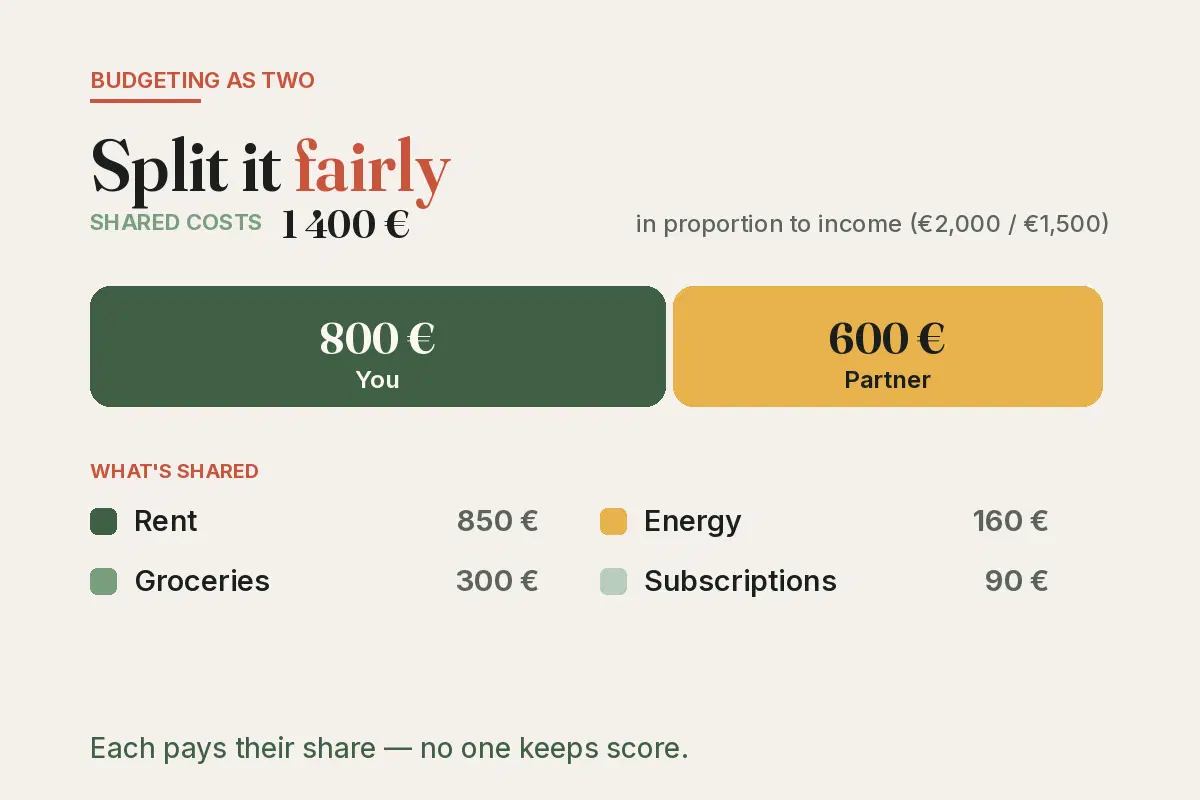
A 50/50 split seems fair on the surface, but it's not when incomes differ significantly. The fairest method is proportional splitting.
Example: Alex earns $4,000/month and Jordan earns $3,000/month. Their combined income is $7,000. Alex represents 57% of the income, Jordan 43%. If shared expenses are $3,500/month, Alex contributes $2,000 and Jordan contributes $1,500. Each keeps the rest for personal spending and savings.
This approach ensures neither partner feels squeezed while the other has excess. The key is agreeing on what counts as "shared expenses" — rent, utilities, groceries, insurance, and joint savings goals are the usual candidates.
Setting shared savings goals
Joint projects — vacation, home purchase, wedding — require coordinated saving. Sit down together, prioritize your goals, and create a dedicated envelope for each in Plan & Multiply.
Set up automatic contributions from each partner based on your agreed split. Automation removes the temptation to skip a month and ensures steady progress. The app shows both partners the same dashboard, so progress is always visible and shared.
The monthly money date: a habit that works
Once a month, take 15 minutes together to review: what was spent, are savings goals on track, and does anything need adjusting? Plan & Multiply generates a monthly report that makes this conversation easy.
This regular check-in transforms money from a taboo topic into a shared project. It's also a chance to celebrate wins: a goal reached, a budget respected, a debt paid off. The Serenity Score gives you a single number to track your joint financial health over time.
Budget as a couple without sharing bank access
Here's what makes Plan & Multiply different from every other couple budget app: you never share bank credentials. No Plaid connection, no linking accounts, no third-party aggregator seeing your transactions.
Instead, couples connect through a simple QR code scan. Both partners see the shared budget, shared envelopes, and shared Serenity Score. Each person logs their own expenses. Full transparency, zero privacy compromise.
This is especially important for couples who aren't ready to fully merge finances — new relationships, couples with separate bank accounts, or anyone who values financial autonomy while still budgeting together.

