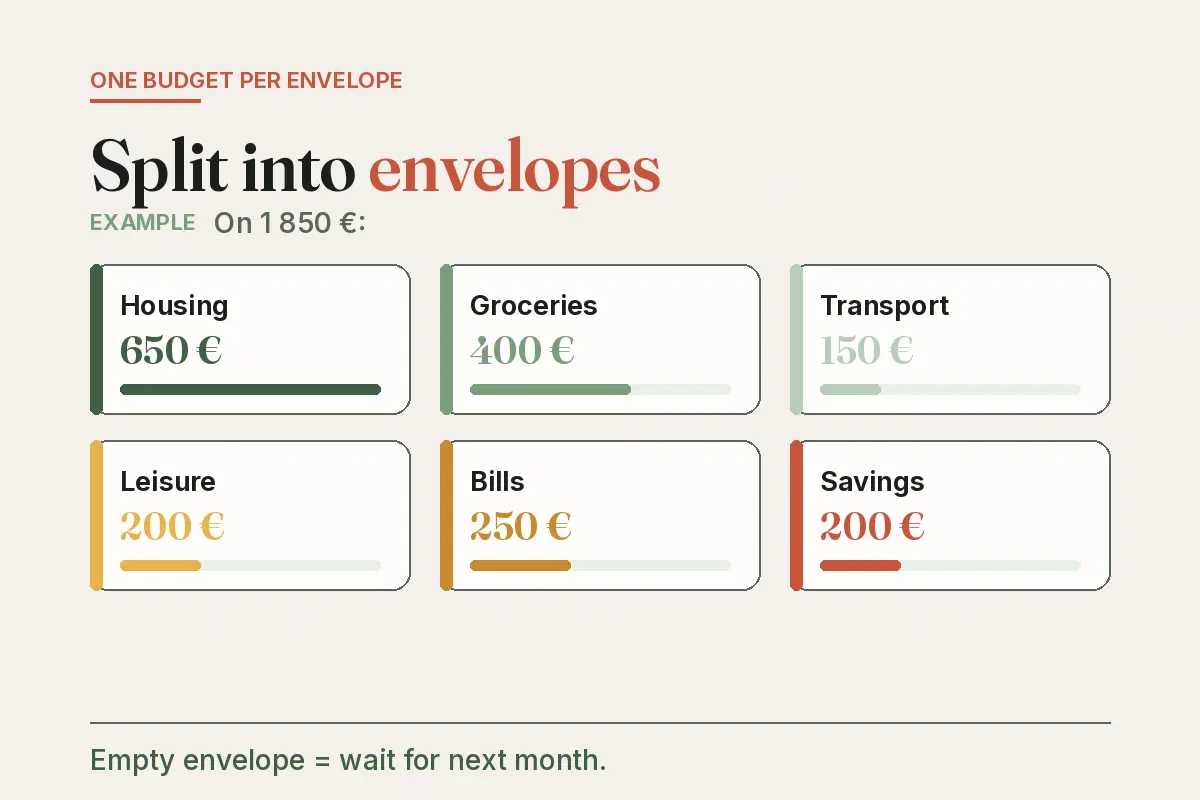
What is envelope budgeting?
Envelope budgeting is one of the oldest and most effective budgeting techniques. The concept is simple: at the beginning of each month, you divide your budget into separate envelopes — one for each spending category.
When you make a purchase, you take the money from the corresponding envelope. When an envelope is empty, you stop spending in that category until next month. Envelope budgeting naturally prevents overspending without requiring willpower.
How to set up envelope budgeting
Setting up envelope budgeting takes four steps:
- List your spending categories: groceries, transportation, entertainment, health, clothing, gifts, savings. Keep it between 5 and 8 categories to stay manageable.
- Set a budget per envelope: base your amounts on the last 3 months of actual spending. Be realistic, not aspirational. Don't forget a savings envelope.
- Fund your envelopes on payday: as soon as income hits your account, distribute the money into each envelope. If you get paid biweekly, see our budget-by-paycheck guide for how to split envelopes across two paychecks.
- Spend only from envelopes: every purchase comes from the right envelope. No exceptions, no borrowing between categories (at least for the first month).
Envelope budgeting example: monthly breakdown
Here's an envelope budgeting example for a monthly budget of $3,000 (after rent and fixed bills are covered):
- Groceries: $500 — weekly shopping and meal prep
- Transportation: $200 — gas, transit, rideshares
- Entertainment: $250 — restaurants, movies, activities
- Health & wellness: $150 — pharmacy, gym, self-care
- Clothing: $100 — monthly wardrobe budget
- Gifts & surprises: $100 — birthdays, holidays, unexpected needs
- Savings: $400 — goals and emergency fund
The remaining $1,300 covers rent and fixed expenses (automatically deducted). Envelopes only manage your variable spending — the part you actually control.
Cash envelope system: the TikTok trend explained
The cash envelope system (also called "cash stuffing") went viral on TikTok with over 4 billion views. People physically sort cash into labeled cash envelopes or binder pouches — one for each spending category.
The cash envelope method is simply envelope budgeting rebranded for social media. The appeal is visual and tactile: seeing your money physically decrease makes spending feel more real. But there's a practical problem — most of us pay with cards, not cash.
That's where digital cash envelopes come in. Apps like Plan & Multiply give you the same psychological benefits of a cash envelope system — visual envelopes, clear limits, the satisfaction of staying on budget — without the hassle of carrying cash.
Envelope budgeting: physical vs digital
| Criteria | Physical envelopes | Digital (Plan & Multiply) |
|---|---|---|
| Visual impact | High — you see cash disappear | High — progress bars and alerts |
| Card payments | Not supported | Fully supported |
| Risk of loss/theft | Yes — cash can be lost or stolen | None — data on your phone |
| Spending reports | Manual counting | Automatic monthly reports |
| Couple sharing | Difficult to coordinate | QR code sharing, no bank needed |
Best envelope budgeting apps 2026
If you want to try envelope budgeting digitally, here are the best apps in 2026:
- Plan & Multiply — free tier with 3 flexible envelopes, Serenity Score, offline budgeting, partner invitation and read-only access. Premium unlocks higher limits, two-way sync and advanced shared tools.
- Goodbudget (free / $10/mo) — decent envelope system but limited to 10 envelopes on the free tier. Cloud-based, requires internet.
- YNAB ($14.99/mo) — uses "buckets" instead of envelopes. Powerful but expensive, steep learning curve, requires bank sync.
- EveryDollar (free / $17.99/mo) — Dave Ramsey's app. Basic free tier, bank sync only on premium.
- Mvelopes ($5.97/mo) — dedicated envelope app with no free tier. Requires bank connection.
For a detailed pricing comparison, see our best budgeting app 2026 comparison.
Envelope budgeting mistakes to avoid
- Too many envelopes — Start with 5 to 7 categories maximum. Too much granularity leads to overwhelm and abandonment. You can always add more later.
- Unrealistic amounts — Base your envelopes on your actual spending from the last 3 months, not on what you wish you spent. An honest budget beats an ambitious one that fails by week 2.
- No "unexpected" envelope — Always keep 5-10% of your budget for surprises. Life doesn't respect budgets. Car repairs, medical copays, birthday gifts — they will happen.
- Quitting after a bad month — The first month is always rough. Your estimates will be off. That's normal. Adjust and try again. Envelope budgeting works over months, not days.
- Not tracking small purchases — That $4 coffee, the $2 parking meter, the $7 snack. Small purchases add up to hundreds per month. Log everything, or your envelopes become meaningless.
Why envelope budgeting can be useful
Envelope budgeting makes category limits visible before you spend:
- Visible trade-offs: spending from one envelope immediately reduces what remains for that category, so the consequence of a purchase is easier to see.
- Mental accounting: when money sits in separate envelopes, your brain treats each as an independent fund. Spending from your "dining out" envelope doesn't feel like it affects your "groceries" budget. This compartmentalization prevents the "I'll just take from somewhere else" trap.
- Visual depletion: watching an envelope empty creates a powerful visual signal. Your brain understands "running out" intuitively — far more than a declining bank balance.
- Visible limits: manual tracking keeps the remaining amount in each envelope explicit. Results depend on the limits you set and how consistently you update them; no fixed saving rate is guaranteed.
Envelope budgeting for couples
Envelope budgeting is especially powerful for couples. Instead of arguing about who spent what, you both see the same envelopes, the same limits, and the same remaining balances.
With Plan & Multiply, couples connect via QR code — no shared bank accounts needed. You can create shared envelopes (groceries, rent, utilities) and personal envelopes (individual spending money). Both partners log expenses from their own phone, and both see the shared dashboard in real time.
For more on couple budgeting, see our complete guide to budgeting as a couple.
Envelope budgeting with Plan & Multiply
Plan & Multiply turns your phone into a smart envelope system. Create as many envelopes as you need, set a monthly ceiling for each, and log your expenses as you go.
The app alerts you when an envelope reaches 80% of its limit, so you can adjust before it's too late. The monthly Serenity Score shows you which categories you nailed and which need work. No bank connection, no aggregators — just you and your budget.
Whether you're a budgeting beginner or an experienced budgeter looking for a better system, envelope budgeting with Plan & Multiply delivers results from month one. Download free on iOS and Android.
The envelope method is also a concrete lever to get out of overdraft: by capping each category, you stop spending money that isn’t there.

