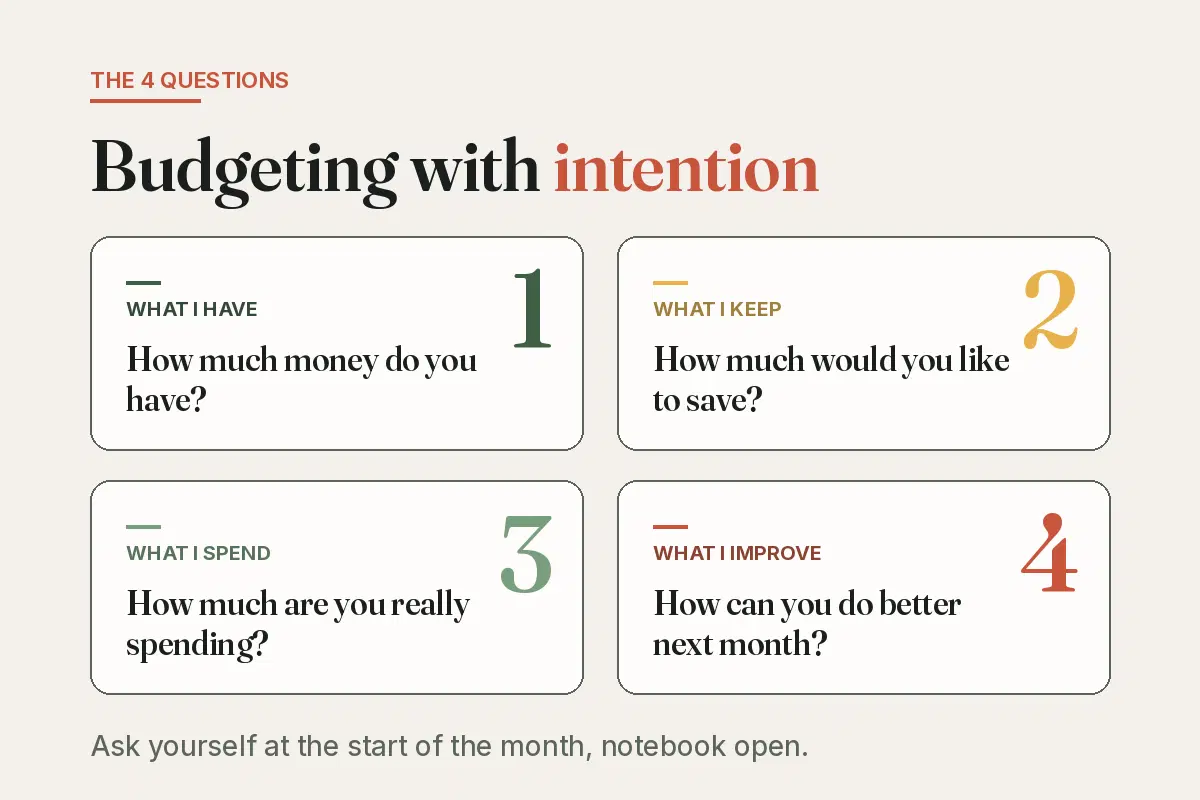
What is the kakeibo method?
The kakeibo method (pronounced “kah-keh-boh”, sometimes spelled kakebo) is a Japanese budgeting method invented in 1904 by Hani Motoko, Japan's first female journalist. The word means “household financial ledger” in Japanese.
The core idea behind the kakeibo method is powerful in its simplicity: by mindfully recording every expenseand regularly reflecting on your spending habits, you naturally become more intentional with money. Over 120 years later, the kakeibo method remains one of the world's most popular budgeting approaches — and the foundation of Japan's culture of saving.
The 4 kakeibo method spending categories
The kakeibo method organizes all spending into 4 simple categories:
- Needs (Survival) — Essential expenses you cannot avoid: food, housing, transportation, health, utilities.
- Wants (Optional) — Things you choose to buy but don't strictly need: dining out, coffee shops, shopping, gadgets.
- Culture & Leisure — Personal enrichment: books, movies, concerts, subscriptions, classes, hobbies.
- Unexpected — Unplanned expenses: repairs, gifts, medical emergencies, surprise bills.
This four-category system is what makes kakeibo so effective: it's simple enough to remember, yet precise enough to reveal your spending patterns at a glance.
How to use the kakeibo method: step by step
Start of month: planning
- Write down your net income for the month
- Subtract all fixed expenses (rent, insurance, loans, subscriptions)
- The remaining amount is your money left to spend — to distribute across the 4 categories
- Set a monthly savings goal
Every day: tracking
Log every expense in its category. This is the heart of kakeibo: the act of recording creates mindful awareness that naturally reduces impulse purchases. The manual step makes each purchase visible, but it does not guarantee a fixed reduction in spending.
Every week: reflection
Kakeibo requires a weekly check-in with 4 questions:
- How much did I spend this week?
- How much did I manage to save?
- Which purchase could I have avoided?
- What will I improve next week?
End of month: review
Compare actual spending with your plan. Analyze the gaps. Celebrate your progress. Adjust amounts for next month. With Plan & Multiply, these reports are generated automatically.
Kakeibo method vs envelope budgeting: what's the difference?
| Criteria | Kakeibo | Envelope budgeting |
|---|---|---|
| Categories | 4 fixed categories | As many as you need |
| Review cycle | Weekly + monthly | Monthly |
| Philosophy | Mindfulness and reflection | Spending caps |
| Origin | Japan (1904) | USA (Dave Ramsey) |
| Best for | Understanding habits | Controlling spending |
Plan & Multiply combines both approaches: budget envelopes work as spending caps, while offering the categorized tracking and reflective reviews of kakeibo.
Why a digital kakeibo method app beats paper journals
- Always in your pocket — Log expenses immediately, not at home hours later when you've forgotten half your purchases.
- Automatic calculations — No manual math, no errors. Totals, averages, and reports are generated instantly.
- Visual dashboard — Charts, progress bars, Serenity Score: your budget comes alive with data visualization.
- Searchable history — Find any expense in seconds, compare months side by side.
- Couple sharing — Traditional kakeibo is individual. Plan & Multiply enables family sharing via QR code.
Kakeibo and cash stuffing: the perfect combination
Cash stuffing (the TikTok trend of dividing cash into physical envelopes) pairs perfectly with kakeibo. Use the 4 kakeibo categories as your foundation, then create cash stuffing envelopes within each category for more granularity.
For example, within kakeibo's “Needs” category, create separate envelopes for groceries, transportation, and healthcare. Plan & Multiply makes this combination seamless with its flexible envelope system.
Best free kakeibo alternatives in 2026
- Paper kakeibo book ($10-20) — The original format, but hard to maintain consistently and impossible to share with a partner.
- Excel/Sheets template (free) — Flexible but not mobile, no notifications or visualizations.
- Plan & Multiply (free to start) — a private digital kakeibo option. Budget envelopes, Serenity Score, couple sharing, real-time money left to spend tracking. No bank sync required, works offline.
The science behind the kakeibo method
The kakeibo method's effectiveness is backed by behavioral science. The method leverages several well-documented cognitive principles:
- The pain of paying — Manually recording expenses triggers the same neural response as physically handing over cash, making you more reluctant to overspend.
- Implementation intentions — Setting budget amounts at the start of the month creates concrete plans that reduce decision fatigue.
- Reflective practice — Weekly reviews build self-awareness, the foundation of behavior change.

